WHO CARES? (Diffusion is All You Need)
If you at any point logged onto X/Twitter this week or pay attention to every news article about OpenAI or Anthropic, you probably have seen the controversy over the solution to the Navier-Stokes problem. The argument was basically over whether the partial result was properly derived internally using OpenAI’s models or was based on research accessed via private chat logs. Actually, OpenAI only started working on this because they heard through X/Twitter that Anthropic had cracked two Millenium problems internally. Obviously, this is super important, because whoever gets there first would imply that lab’s models are further along the quest to AG-
Who cares?
In the Fed’s July 2026 assessment, it found that productivity trends across different industries (rated based on low, medium, or high adoption/exposure to AI) has remained remarkably consistent. Yet we have people at labs telling everyone on X that this supposedly insane thing they’ve created is out of their control and they’re going to die (and then they wonder why are people so anti-AI?)
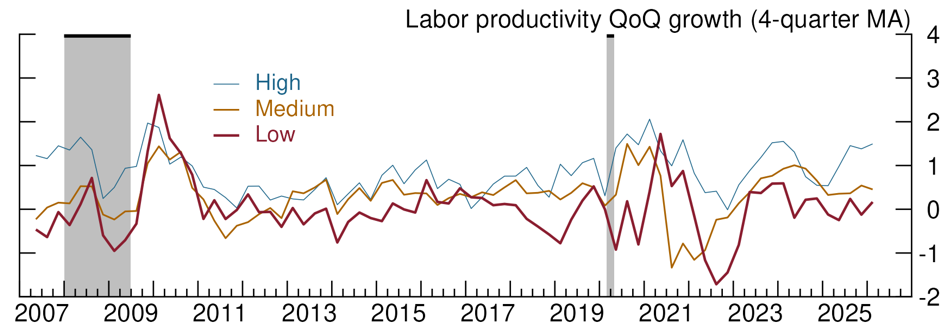
In other words, the unprecedented scale of capital and talent that has been thrown at AI has not (yet) significantly moved the needle in some of our most critical industries. GDP growth has been remarkably consistent since 2023 (standard 2-3% range, 1.5% annualized this year), while spend on AI development has gone vertical (50-70%+ a year, conservatively).
I’m not saying this to say AI is bad, or a fad. In fact, earlier, I lied a little bit. I do care; I understand that this is an important result towards a more generalized Navier-Stokes solution that would meaningfully impact everything from aerospace to biotechnology. I understand the weight of AI solving Millenium problems, escaping confinement, and setting up rogue messaging boards. I’m lying if I’d say its not messed up that an Alignment Lead at Anthropic thinks AI kills us all in the next decade with >10% odds
In fact, I wouldn’t mind if we paused development here, just for a little bit, because in my mind, the risks are starting to somewhat outweigh the rewards. Heretical, I know.
But I also get whiplash, sometimes. I spend a good chunk of my time talking to and occasionally working with companies across a wide-range of industries that aren’t always on the absolute frontier. These include (not exhaustive): regional large players in ecommerce fulfillment, asset backed lenders, healthcare vendors, industrials, etc. For some of these, if they mess up, that means that critical medical equipment at a hospital doesn’t get fixed in time, or that someone may not get something they ordered online that they desperately need. You get the point.
I don’t think any of them really care that an AI solved a Millenium Problem just yet. I can tell you what they do care about.
They do care about efficient implementations of this new technology that lets them actually see and quantify productivity gains (i.e. $X saved on this task, or Y hours saved). They do care about bringing their data systems into the modern age so they can even get to thinking about how to apply this technology. They do care about this not breaking the bank
Only when these firms see massive outsized productivity growth is when maybe, just maybe, the Navier-Stokes solution will start mattering both to them and their employees and customers. But they have not (yet). Model capabilities have vastly surpassed any real adoption or real rate of economic growth. See chart below:
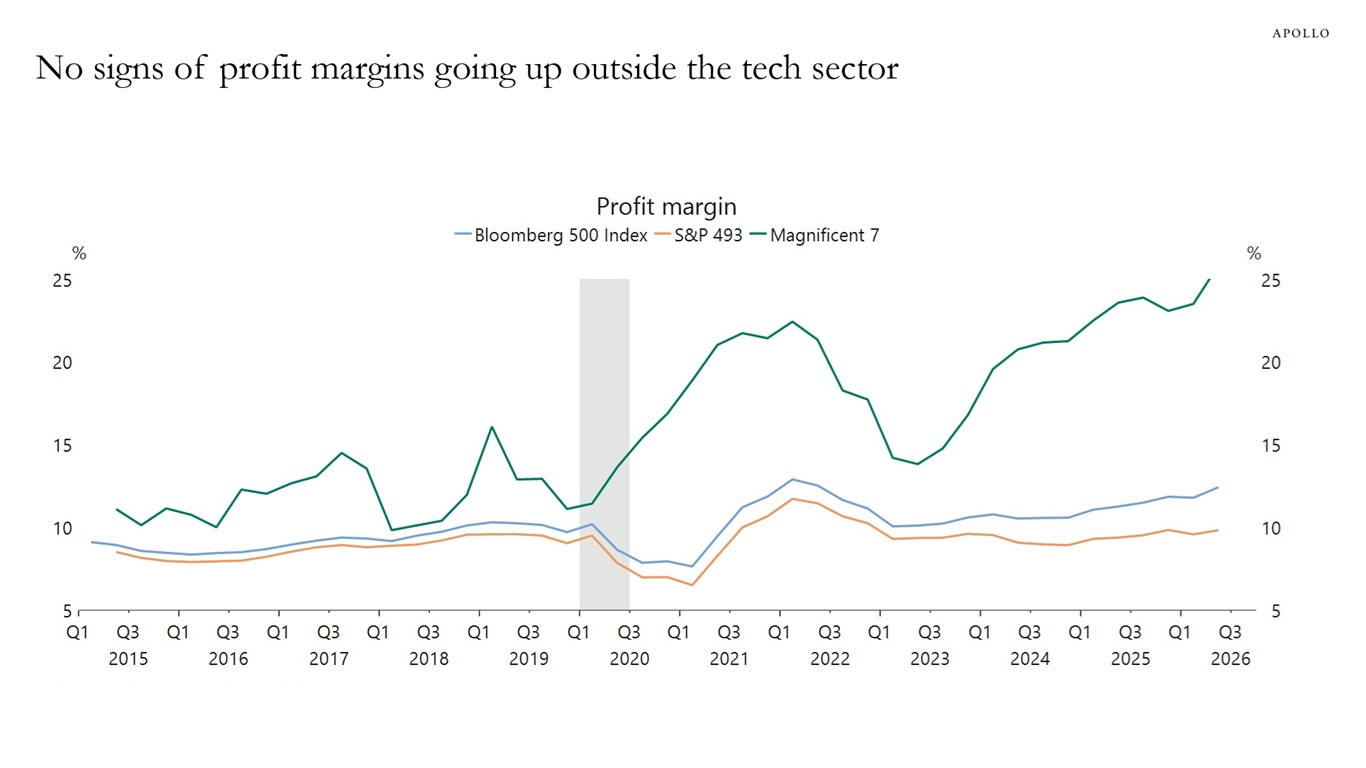
It almost seems to be that the most important immediate problem isn’t continuing to build a Tower of Babel, but rather to accelerate the diffusion of the most important technology of our time. A riot against Baumol’s cost disease
This diffusion work (agentic labor, transformation, whatever you want to call it; I prefer diffusion) is, unsurprisingly, tricky. Part of it is because, technically, there’s a lot of edge cases at implementation time: really weird ERP you haven’t seen, decision processes that sit in one person’s head that haven't been codified anywhere, data is super messy, etc. In my personal experience, a lot of the work involved with diffusion has been organizing, triaging and cleaning up data, in tandem with the firm’s native workforce, in a form that’s easy for an agent to use (oNToLogY, if you will). That being said, a lot of this has and will continue to be massively easier to handle as models improve.
The other part, however, is irreducible because it has very little to do with AI and a whole lot to do with your fellow human beings. What maybe is less understood, or at least willfully ignored, by the median lab researcher is a better technology does not guarantee immediate adoption. The rationalist thinker at an SF lab might believe that one should use the best model in their R&D because it advances internal capabilities faster, and faster is better. They are correct. The rationalist thinker at a Midwestern industrial distribution company might be more concerned with the capital and labor investment needed to implement a new technology weighed against core business goals, the need to retrain their workforce to adapt, and any associated core business risks.
They are also correct.
My point being that a lot of diffusion work is empathy. It’s not enough that a model is really good to force adoption. Leadership needs to be bought in for any diffusion to work (trust!). They need to understand why they’re spending on this technology, why it shrinks their SG&A or COGS (if services) spend. It needs to sometimes layer on systems that are 1 or 2 technology generations removed. Over time, it will also become an input question: can we get the max productivity out of this intelligence product at the lowest possible cost and, if so, how?
Most importantly, in the ideal state, the implementation (or implementor) needs to be aligned with the core business that they are working with. If you are working with a lender, your core north star should almost always be focused on a faster, better, more accurate underwriting process, for example.
This of course opens up the venue for a lot of existing, and future businesses. What is definitely well-explored are the crop of AI-native service firms or vendors across areas like tax, insurance, logistics, etc. Many of these either (a) supplant BPOs in an existing industry at far more aligned, outcome-based pricing, or (b) act as an entirely-contained competitor (i.e. a new law firm) within said industry with far better unit economics. There are also, of course, the holding companies, which own actual economic stakes in the businesses they are transforming, such that the value of AI diffusion is captured not as a vendor, but as an owner. In fact, I suspect that the former category will eventually tend to the latter category over some limit of time.
If you’ll let me risk reasoning by analogy, it seems (or I hope?) that many of those folks would agree on the distinction between diffusion being a pure technological effort, and one that requires finesse beyond the screen.
I also think that there is a lot of room to figure out novel and interesting structures around aligning the diffusion with AI, economically, with a business that goes beyond being a vendor or an outright owner. For example, if I build an amazing agentic system to handle pricing/quoting for an equipment distributor, then surely:
- Parts of that system are relevant to similar companies in that sector
- The company I worked with has way more innate distribution and trust advantage in their sector
- I’m better off figuring out a new joint structure/entity to work with them on generalizing that work
- This is potentially a much faster way to make sure AI diffuses, effectively, across that entire sector
- This accelerates making sure AI shows up as productivity growth and the workforce gets comfortable with it
I don’t think we’ve tapped the full breadth of creative ways in which to both enable and monetize diffusion effectively (JVs, anyone?).
Anyways, this is all to say that the bottleneck to any relevant diffusion seems to very much NOT be model capabilities (capabilities have far outstripped rate of adoption) and very much about trust, empathy, and novel thinking. I’m sure every business would love their workflows captured as ontologies, their processes automated and fed into systems that RL over open-weight models to serve tailored inference at a cheaper cost. But there’s a lot to get done, much of which is very human, to get there.
To me, diffusion seems to be more important at this juncture than absolute model dominance. To get the average person or business to care about Navier-Stokes or genuinely believe AI is a force multiplier, they need to see a model meaningfully improve their life, work and the systems they rely on. We want to see productivity growth massively inflect upwards across all sectors. We want to see people’s lives get better. They absolutely do not need to be warned repeatedly that the Singularity is coming, and that AI will kill all of us within a decade.
To get there, look no further: Diffusion is All You Need.
Thank you to Jake Taylor, Smac, and Ethan Ding for their feedback on this article.