when everything goes to 0
Originally published on X ↗
Before you read the title and jump to conclusions, no, this is not about any sort of investable asset.
What this is about is something that's been on my mind (and many others from what I can tell from my small bubble of investors/operators/traders in SF/NYC).
What's left standing when the cost of software goes to 0?
To be honest, I don't have a perfect answer for this yet, and I'm skeptical of anyone that claims they do. All I can offer the reader here is my thinking around it as someone who's spent time in venture, building software, and liquid markets.
Let's jump in.
Vibing with Bits
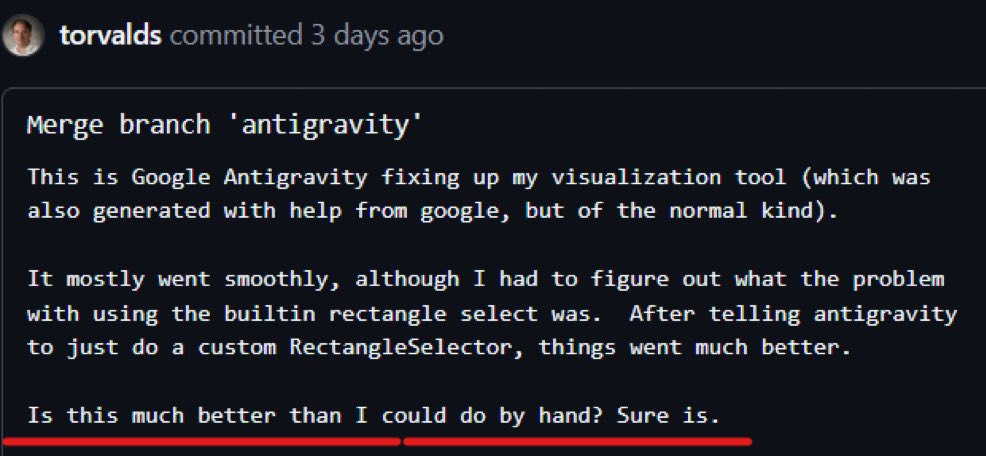
When I say the cost of software is going to 0, that probably isn't a surprise. Of course vibecoded code quality may not be to the standards of artisan engineers, but when people like Linus Torvalds are admitting vibecoding is useful to him, and strong companies like Ramp are having more PRs pushed by agents than humans, it's really hard to claim that this will not eventually replace most software workflows.
Guillermo Rauch @rauchgJan 11 ↗ 10 days into 2026:
- Terence Tao announces GPT & Aristotle solve Erdős problem autonomously
- Linus Torvalds concedes vibe coding is better than hand-coding for his non-kernel project
- DHH walks back “AI can’t code” from Lex podcast 6 months later
An acceleration is coming the likes of which humanity has never experienced before
Aakash Gupta @aakashguptaFeb 10 ↗ 57% of merged PRs at Ramp in the last 24 hours came from a background agent. Most companies haven’t even started.
The architecture Ramp built matters. Their agent Inspect runs in sandboxed VMs on Modal with full access to everything a Ramp engineer has: Sentry, Datadog, GitHub, CI/CD, feature flags, databases, live preview environments. The agent doesn’t just write code. It runs tests, checks telemetry, verifies frontend changes with screenshots, and opens PRs that pass the same review bar as human-written code.
This is why the number is so high. Model intelligence was already sufficient. Environment parity was the missing piece. Once agents have the same context and tooling humans have, adoption compounds because engineers stop treating the agent as a side tool and start treating it as a parallel teammate running unlimited concurrent sessions.
The product development implications are massive. PMs at Ramp now use Inspect during QA to make changes in real time instead of writing tickets. Designers can ship fixes without waiting for sprint capacity. The marginal cost of implementing a small change drops to near zero, which means the backlog starts to dissolve.
Most engineering orgs are still debating whether to adopt Cursor or Copilot. Ramp already moved past the foreground agent phase entirely. Background agents that run autonomously, verify their own work, and produce merge-ready PRs at scale.
The gap between companies measuring their agent PR ratio and companies that haven’t built the infrastructure to support one is going to define the next era of product velocity.
Of course, this doesn't just apply to software- a lot of digital flows in general are being replaced. But that's a conversation for another time.
In tandem, harnesses are getting better than before. Openclaw is giving everyone a Jarvis in their pocket. There's a million great startups building tools, skills, and other auxiliary infra to let agents do and access more. In short, the friction around integrating agents into almost any digital workflow is getting eroded to none. This has massive ramifications both for consumers (and the types of products they use) and for enterprises.
You kind of see this in the reaction of public markets as AI coding tools have caught on. Take a look at the Standard & Poor NA Software Index on a 6mo time horizon.
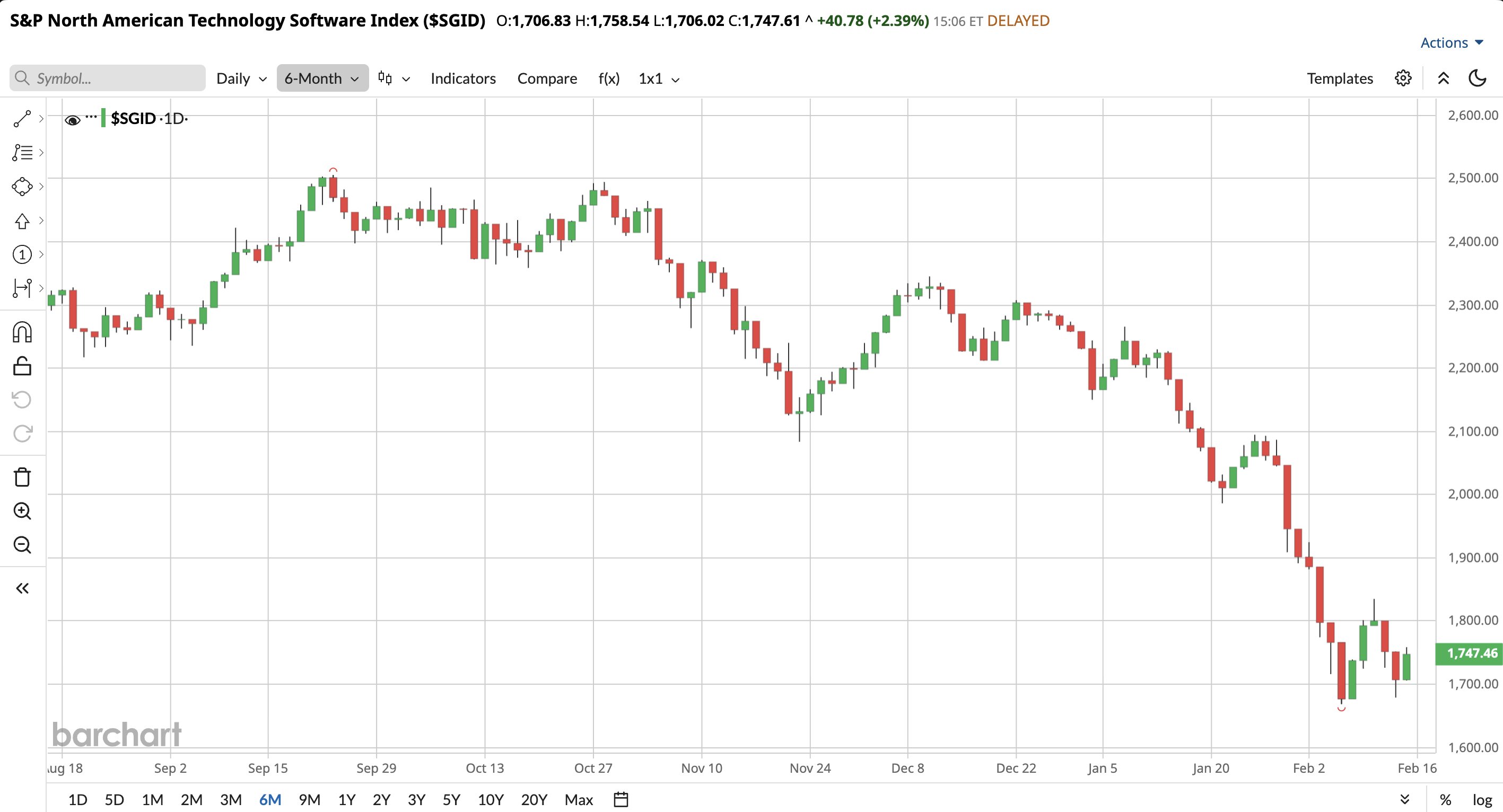
This is all pretty self-obvious, but I always feel like its good to call out the base priors.
With that said, let's go back to our original question: when the cost of software (and digital workflows) goes to zero, what's left?
Put another way, I've been asking myself this question as I think about where I want to spend my time over the next couple years. I have a few convictions:
- Bigger and better companies will be built with far smaller (yet more competent teams) + AI workflows (which matches how talent globally is evolving, a smaller concentration of far more competent people each generation after generation).
- Taste and first-principles reasoning in what, not how, to build will matter far more than any sort of software/talent edge
- The most valuable information in the world is now stuck in people's brains; domain experts may get outcompeted with AI in terms of raw processing, but AI doesn't necessarily have the relationships, the practical know how not found in any training datasets, and the emotional finesse (yet) to get big things done autonomously.
- There are things that matter more than software itself for some businesses; we'll get into this later.
From these 4 anchor priors, I've been building up a framework to think about what kinds of businesses win in this strange new world
Rights to Victory
I like to think about companies in terms of their right to victory. Put another way, take the best possible outcome for a company/idea/team and reverse engineer that into where they are today and what the most critical thing(s) they need to get there.
As a disclaimer, this is talking about software and software-enabled businesses. This (probably) doesn't really apply to deeptech/physical businesses (bio, space, defense, etc.) although they certainly are also benefiting and impacted by AI. Also, there are things that feel universal: good talent, good culture, good taste, good operational finesse, not going of the deep end with spending or shock marketing campaigns etc.
Anyways, right now my thinking is that I've identified three sort of modes of operation/rights to victory for companies doing really well at this moment. There's probably more, but these are the ones most apparent to me
BE A DOG.
There are certain companies who don't necessarily have an entrenched moat in their product of software (at least, not until they basically become an ERP or the ground source of truth for that functionality) but will win by basically being dogs about it.
This means hiring more of the best engineers, salespeople, etc. they can find and just talking to customers earlier, faster and executing on product feedback quicker (+ maybe some pricing shenanigans).
In fact, I expect some of these companies to spend way more time on sales than anything else; as of 2 weeks ago, the cofounder of one notable darling applied AI company mentioned to me that they had way more salespeople that engineers at this point and to me that makes sense.
Another analogy I'll draw is what another founder told me, around it being a very "Chinese" style of operating- build a comparable (or ideally slightly better) product in a fairly crowded sector, undercut or streamline operations where possible, be exhaustive in customer acquisition and retention and do it longer until you outlast or buy the competition.
I think this is certainly viable and there's some parts of this (best talent, work harder and faster) in any company but the downside is that you're always looking over your shoulder with no time to breathe.
Some examples of this are B2B software around sales/marketing, customer support etc. (won't name names, since some people aren't fans of this description!)
It takes a very persistent type of founder + team to win here.
VERTICALIZE, BABY, VERTICALIZE
You know what the best way to make sure that a business in the sector that you're selling to doesn't churn off your software for someone who vibecoded the same thing + undercuts you?
That's right, buy the damn business (or become it).
More specifically, there's been a wave of emerging (1) AI-enabled holdcos and (2) verticalized AI companies.
The idea being that an underlying business/service can be made better by replacing or enhancing existing workflows with agentic systems.
A very non-nuanced example a tax practice may have to do a lot of reconciliation work between various documents for a given client during filing season; easily a task that AI can automate.
The AI Holdco thesis essentially rests on the idea that the acquisition of good quality businesses (with revenue external to anything software-related) combined with sharp teams of applied AI engineers can have their margins expanded through cost-savings or revenue expansion. Businesses like this include Sequence, Long Lake Management, Beacon Software, etc.
Within this space, I've seen two lines of thought. The first follows the idea that you should acquire a good quality business with potential for AI transformation, prove that it works, and then move on to a bigger business (which may be entirely unrelated). The second focuses on rolling up businesses within a dedicated vertical (i.e. tax practices, RIAs, real estate), such that there are superlinear benefits with the Nth+1 business acquired. These come from shared software-enabled back offices, or portfolio synergy where the sum of the whole is more valuable than the individual parts (i.e. full-stack tax practice, or compounded proprietary data moat from providers in a sector).
The other end of this is something like a Corgi (insurance carrier with AI) or Crosby (AI-powered law firm). Essentially, you are a competitor here to existing providers in that sector (i.e. other carriers of law firms) but your edge comes from having the best streamline workflows + software enablement from having a more tech-like DNA
I think all models here are very interesting provided the talent to back them matches. You wouldn't build a holding company without decent private equity/financial acquisition experience, and you wouldn't build a verticalized company without talent in that domain. But I think AI accelerates the software enablement of businesses that traditionally have nothing to do or use very antiquated tech, and there are massive outcomes to be made here (just different than what the average tech crowd may be used to).
IT WAS NEVER ABOUT THE SOFTWARE
The last one I think about is building in industries where the stickiness or moats of products were never about the software.
A good example that comes to mind (as someone who has spent the past 5 years looking at it) is money. Financial services like banks, or brokerages can have pretty good retention because money is stick; moving it around is a pain and if a financial service/app is at parity with most providers in the industry there's not *really* a reason to switch (although, if that doesn't hold true for consumer needs, they will churn). Money is sticky, so if you have the right to hold that money or move it around (i.e. bank licenses, RIA/broker-dealer licenses, etc.) and a pretty decent product, you can retain your customer.
Other examples that are more well-known are marketplaces and social media apps which now benefit immensely from compounded network effects.
Another example is industries where the social graph has a high-degree of edge weighting i.e. relationship driven. One rabbithole I went down was the world of T&E (Trust and Estate) planning for HNWIs/UNHWIs. Given the discretion, assets under management, and types of clients, you may not be surprised to learn that some providers (i.e. a PPLI carrier) will have had relationships with other providers that can go back 100+ years. The optimization function here is not necessarily working with the best partners, but rather the ones you trust.
This is fitting; in an era with increased digitalization and connectivity, trust is a scarcer resource and a moat. These types of industries are VERY hard to penetrate, but if you can, and you provide something both useful and valuable, you can entrench yourself in the social graph. Trying to figure out ways to rig the game board in your advantage makes sense here, but its much more deliberate/"think 5 steps ahead" than your typical "build, iterate, get feedback, and keep going".
I'm also very interested in the businesses in this section and have broadly spent a lot more time around AI x fintech as of the past couple of weeks. I plan on continuing to share findings where appropriate as this continues
To wrap this up since it's already getting kind of long. this is the framework I've been using now. I don't think its perfect, it certainly doesn't have enough priors (working on it) and honestly everything is evolving faster than most can keep up.
But its perpetually changing (and I'll update with thoughts as it does) and has served as a very helpful anchor to disseminate between what rabbitholes are worth hopping down and what are not.
Anyways if you made it this far, I hope this helps you too as you are trying to navigate an evolving world of tech.