HYPERSPECUL(A)T(I)ON (GENESIS II)
Originally published on X ↗
What happens when the greatest game ever played meets infinite intelligence?
You get HYPERSPECULATION.
"Competition is for losers."
Peter Thiel's most famous quote is something that goes through my mind a lot these days in the age of a modern AI gold rush. In just two years since ChatGPT dropped, AI has exploded into every sector imaginable. Coding agents, AI-powered PE rollups, consumer companions, etc.
Which always brings me back to Thiel's quote and the question What can AI be applied to that isn't consensus yet?
Crypto is no exception to its attempt to apply AI. But what's actually come out of that intersection is fairly lacking (as I covered in GENESIS I). Crypto constantly brags about being the "future of markets and speculation" while lamenting that speculation and payments are its only real use cases. Meanwhile, Silicon Valley's AI elite largely ignore markets and speculation entirely.
So it's pretty damn ironic that we've seen almost zero first-principles innovation at the intersection of AI, speculation, and crypto.
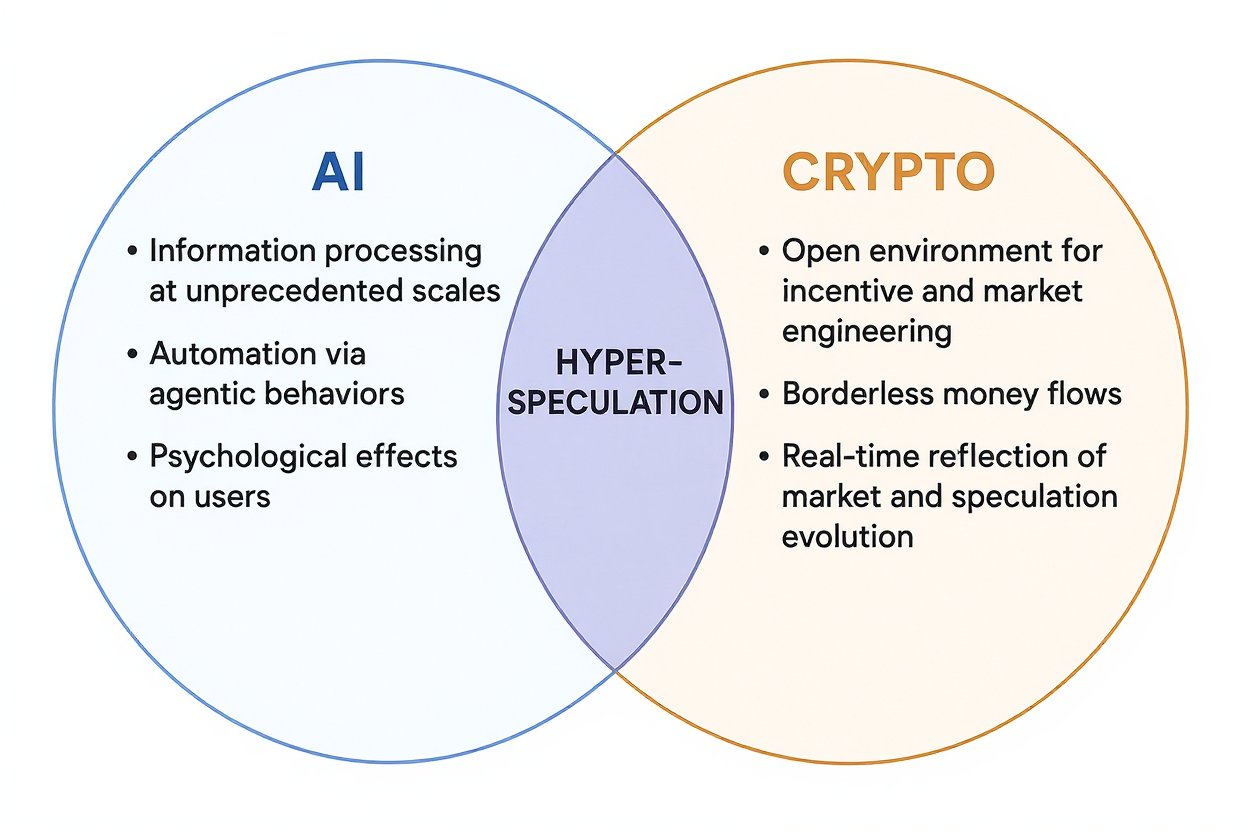
What makes this interesting to me is that there are sets of things AI and crpto are each idiosyncratically good at:
AI:
- Processing information at unprecedented scale
- Automation through agentic behaviors
- Psychological influence on users (see: AI section of Hedonist's Stone)
Crypto:
- Open environment for incentive engineering
- Borderless money flows
- Real-time market evolution
Current attempts don't actually exploit the intersection of these strenghts. But the companies that figure this out? They'll become the next modern financial behemoths.
They'll enable what I call hyperspeculation.
A First Principles Deconstruction
In my mind, any act of speculation can be broke down into a few components:
- The "game" which is whatever arena that the speculation is happening in. This could be anything from the blackjack table to perp markets on Hyperliquid to the NASDAQ. Games have (a) sources of variance (from an external source and/or from other participants in the game) and (b) defined payoff functions (i.e. how much $$$ you make).
- The "players" which is fairly straight forward- the people actually risking value to play the game. More importantly, players have their own process. Players are also motivated by upside (financially) and glory (the feeling of winning and being recognized for it)
- The "process" or how the speculation actually happens. The process can be broken down into discovery, belief, validation, execution and feedback.
The process is diagrammed below:
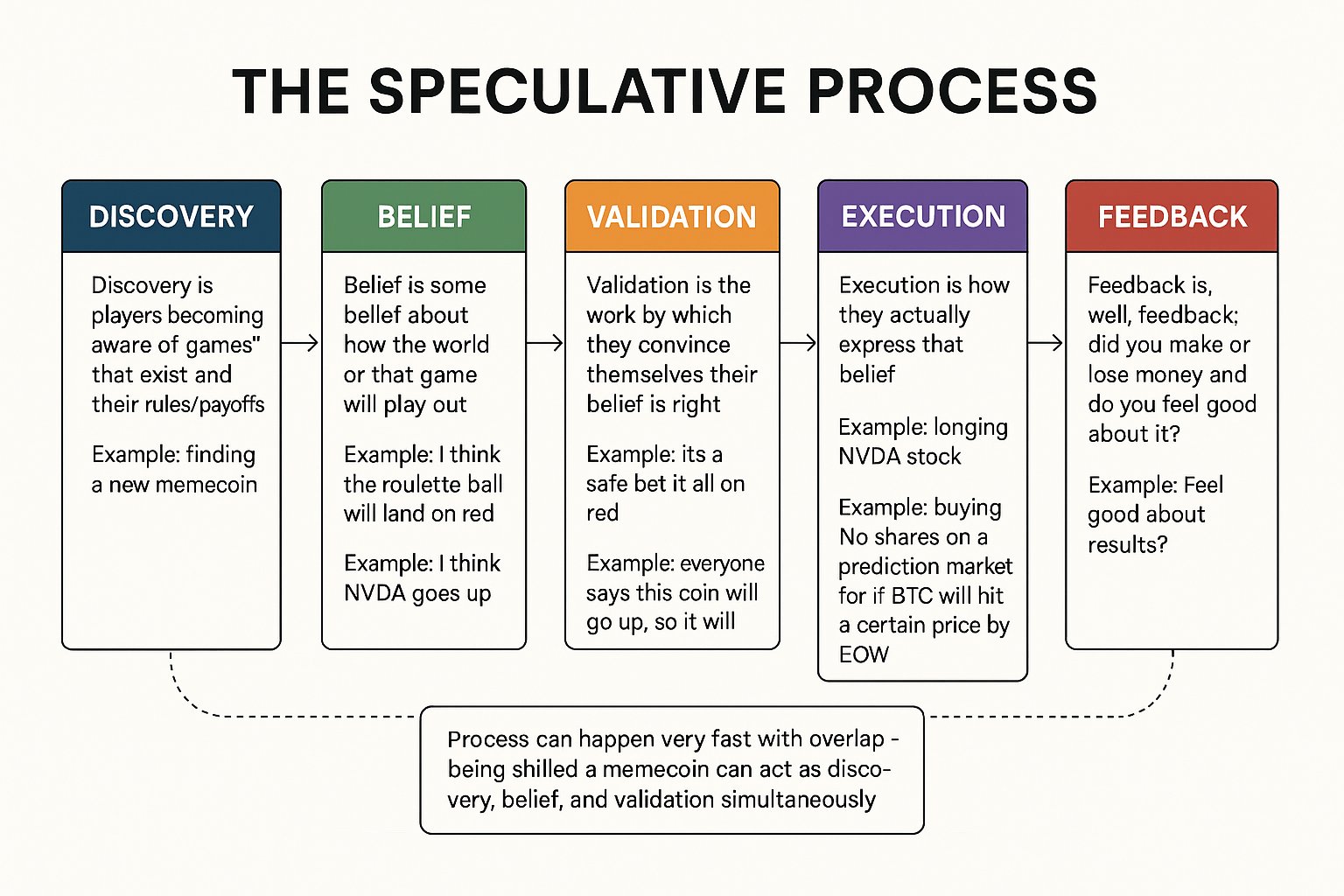
The process generally historically has looked like discovery --> belief --> validation --> execution --> feedback.
It's importantly to note that this can all happen very fast with overlap; being shilled a memecoin in your trading chat acts as discovery (you become aware of it), belief (the chat says its good so it might go up) and validation (all my friends are buying it) in one.
What we've seen is there's immense value in building the "game" (i.e. Hyperliquid, Pump), introducing new "players' (i.e. Stake making gambling social via Drake partnership), and targeting process (i.e. Robinhood making execution dead simple).
So where does AI come in? AI acts as:
- An engineer for new games/markets
- A new type of player in games that changes how the game itself is built
- A new interface for the process
Let's break it down.
AI as a Market Engineer
Today, markets move at Internet-scale. The increased gachafication of everything, the rise in 0DTE volumes, the proliferation of memecoins and perps, etc. everything points to there being demand for new games and new modes of speculation.
AI is technology built for Internet-scale. Which is why one of the most interesting intersections of AI and speculation comes from AI engineering new markets.
A dead simple example of this is what something like @kash_bot is doing. As prediction markets have gotten very popular, the process of listing and resolving new markets is fundamentally a human-defined process.
Kash enables AI models to become market engineers by:
- Spinning up prediction markets based directly on what models identify as trending and high interest using crypto rails
- Using models with tooling (to eliminate hallucination) to automatically resolve those markets
- Using models to let users directly place bets from where they already live (X, TikTok, Instagram).
In other words, with Kash, AI models can automatically create new markets based on what users are interested in, in real-time, faster than humans can. Because Kash is built on crypto-rails, it can also spin these markets up onchain with a market structure customized (i.e. custom AMMs) to these shorter term markets.
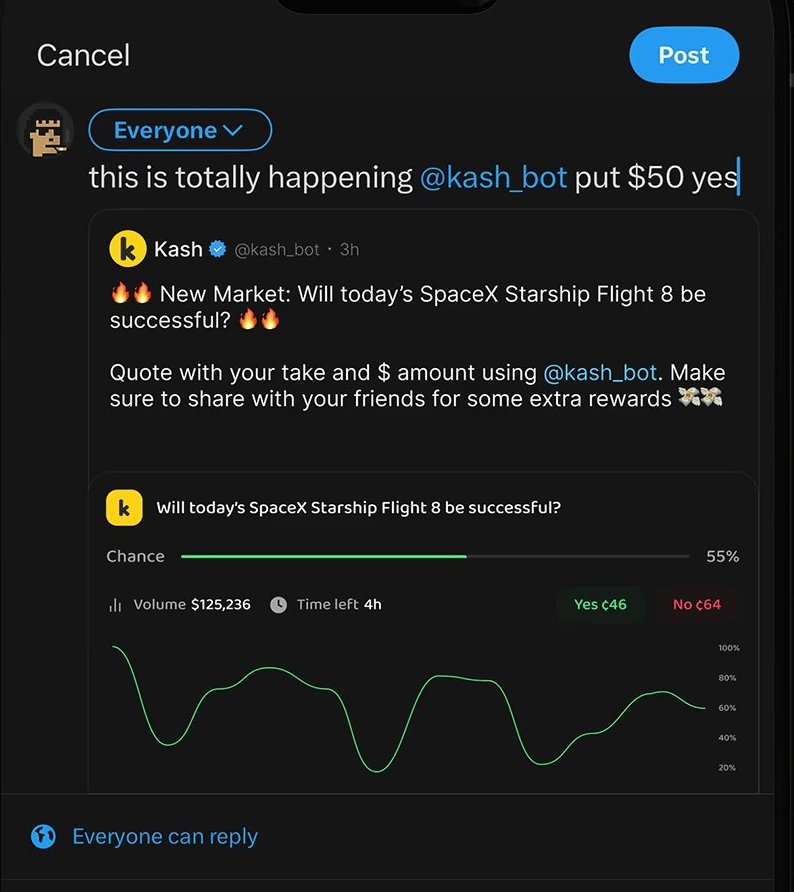
While Kash may not be the place someone would trade, say, election outcomes, it's use of AI as a market engineer with crypto rails for market infrastructure lets it create highly-relevant markets suitable to the attention games we see today faster than humans can.
Extrapolating out, this same approach will be used to create markets over faster-moving information sources, and historically hard-to-quantify asset classes. Already we see AI models being used to enable things like perps on attention (where attention is quantified via a model plugged into X) or semantic markets (i.e. tmr.news).
The end state of this will be AI models/agents will become the best engineers of new markets due to their ability to process and aggregate information faster and distill that into an actionable market.
AI as the Player
I've always found the case study of Pluribus, the AI bot made by Meta and CMU to beat poker pros, fascinating. Perhaps less known than AlphaGo, Pluribus was nonetheless a very interesting breakthrough because it consistently outperformed pros in a game that has fairly high variance and incomplete information. What's particularly interesting about Pluribus is that it did so by bluffing more randomly- something that gave it consistent edge over its human counterparts.
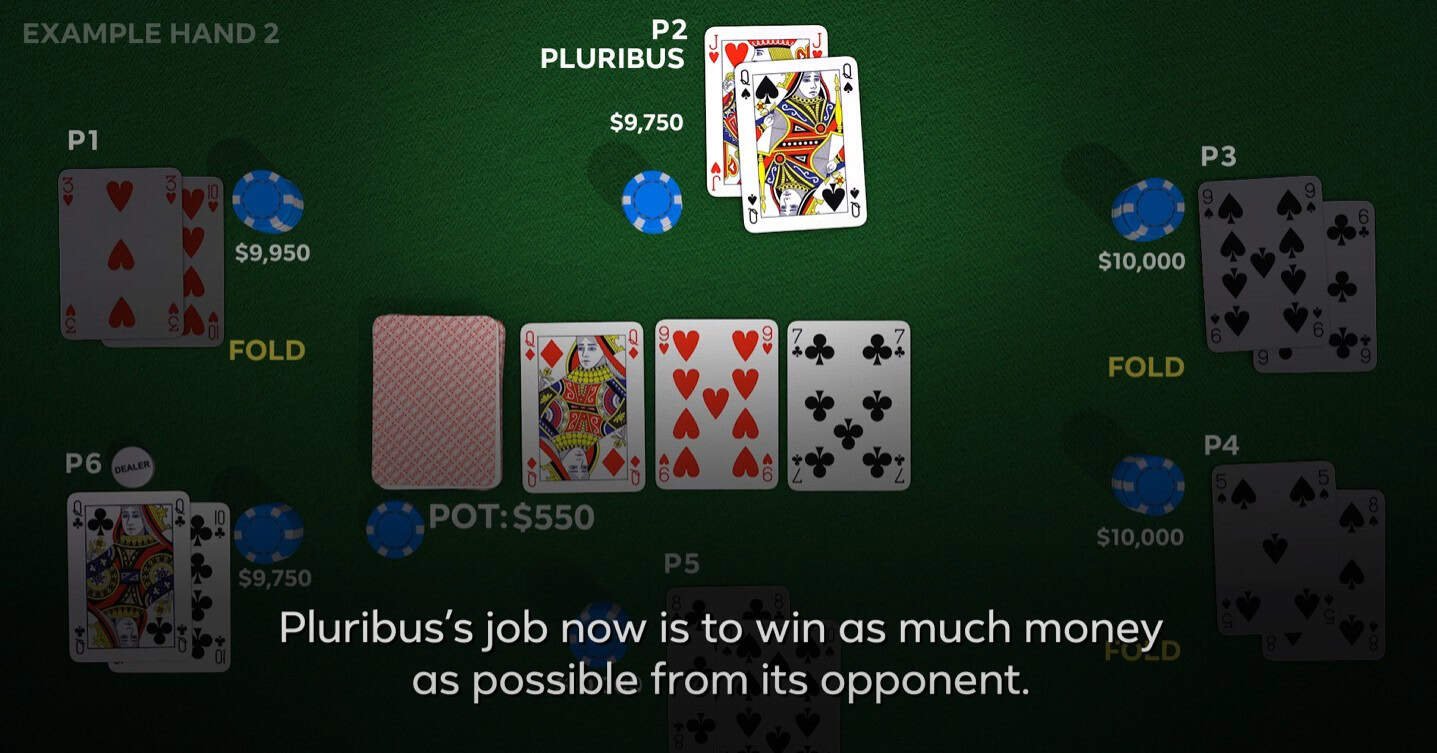
Of course, Pluribus is not alone. There's XtremeBackgammon for backgammon, a plethora of chess bots like Stockfish, and even AI models for newer popular games like Catan.
What makes these interesting is the ability for these bots to act as near-perfect players, enabling historically PvP speculative games to be transformed into PvE speculative games.
Consider for example, Pluribus. Using Pluribus as a "player"/ almost like a raid boss might look like:
- A new mode of poker where a set of players have to collaborate to zero out Pluribus' stack in a set number of hands. Players pay a fee to enter, losers forfeit the fee, winners get a portion of the fee pool
- A new mode where players pay to play Pluribus heads up, with a fee for entry and a score based on performance against Pluribus. Scores are posted on a leaderboard, and the pool generated by fees is distributed to the top performers
- A mode of poker where players can stake on Pluribus as "the house" and other players can play cash games against it, where players staking on Pluribus see their stake grow as Pluribus wins in expectation
And so on (and the same can be said for the other bots I mentioned). As it turns out, it's pretty hard to build these sorts of novel games on traditional rails. On crypto rails, however, blockchains provider a programmatic environment with enshrined money flows that makes constructing any of the above (and tying it in with AI via a layer like @ritualnet) trivial.
LLMs in particular, also become players in other ways. One of the first things we built @ritualnet was @frenrug. Frenrug was an experiment (and to my knowledge, one of the first), in letting users try and convince a set of LLMs to move around financial value (in this case, buy/sell friend.tech keys). Frenrug was a great early example of how an AI as a player could redefine the overall game (in this case, Friend.tech). I keep an eye out on similar experiments (and tangential ones i.e. people trying to use LLMs to MM prediction markets).
Frankly, I've not seen many people actually isolate on new modes of speculation that would come out of this intersection, i.e. an AI-native casino or something similar. It's certainly top of mind for me (and I've ideated on a few product specs), so if it does interest you, DM me.
AI as the Process
In the past year, we've seen some forward-thinking companies realize that LLMS and models provide powerful interfaces for helping users through the speculative process and capitalizing on that. Things like Robinhood Cortex, IBKR's iBot, or the many products targeted at letting users take actions on the blockchain via natural language are perfect examples of this:
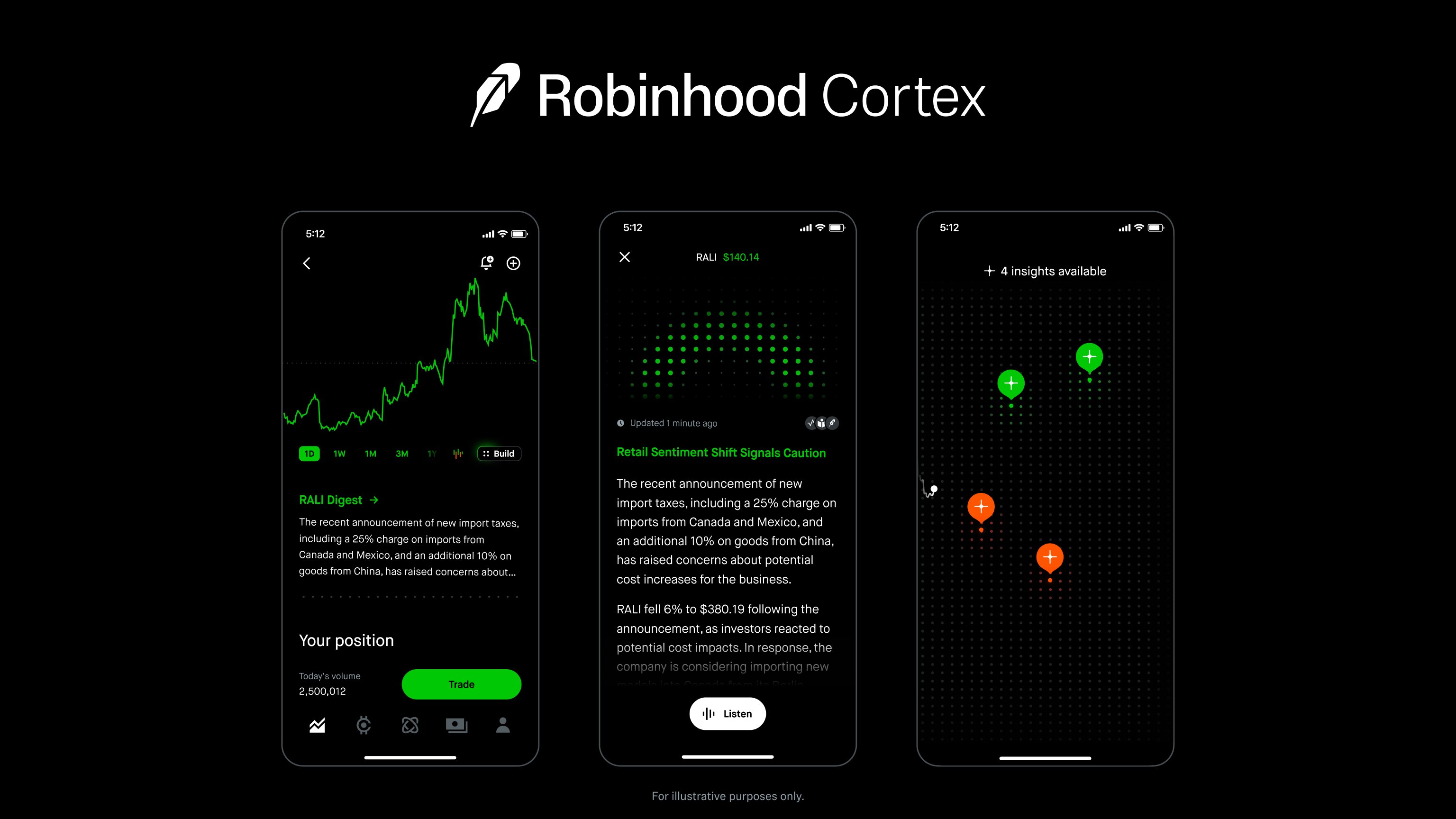
At core, these products so far can be broke down into three categories:
- An interface for making validation easier (i.e. being able to pull information about an asset and other signals) via an AI model
- An interface for putting together portfolios (i.e. generatedassets.com by Public)
- An interface for set interaction (telling iBOT on IBKR to buy options).
I think that all three of these are valuable. What I do think they don't isolate is a very key user behavior: users like using AI models to feel smart.
In other words, a lot of these are pointwise solutions focused around validation or making execution easier. Instead, where models can really shine is completely condensing the entire process, i.e. getting users from belief/discovery to execution as quick as possible.
The ultimate platform convergence will happen with a product in which a user can put in any prompt, any belief, and any piece of media and get matched to the most suitable markets and trades and execute them in one click. Purely offering intelligence isn't the path to a generational company, but rather owning user flow(see: TradingView is worth $3B while Robinhood and IBKR are worth 30x+ that).
This, naturally, extends to relevant crypto markets (perps, memecoins, RWAs). For example, a product that truly nails AI as the interface might surface both a long on Popmart and the $labubu memecoin as trades given the prompt "I see that Labubus are getting popular".
There's actually much more to be said about this, and I've seen a few teams starting to build towards this, but there's nuances in user behavior and product construction that I think make for a winning platform here. More specifically: I'm actively working with a team building towards this, and if this is something that interests you, you should DM me.
Either way, I'm fairly convicted that the product that encapsulates the entire process in one AI-driven workflow will be worth much, much more than what people may even imagine.
Towards Hyperspeculation
These three categories in tandem- AI as a game creator, as a player, and as the process- will ultimately enable hyperspeculation.
When models can spin up new games/markets as quickly as they become wanted, when they can participate in and reshape how these markets work, when they provide the easiest, fastest way to discover and interact with these markets then we will see a exponential rate of speculation I think people will find it hard to fathom, even today.
Crypto, of course, plays a role in this. As the best way to create and access new games/markets, it will be integral to any sort of product thats built at the intersection here (for all of these categories).
Speculation is what crypto has the best PMF with empirically, and if AI x crypto as a category is to move forward, then we must build the best products in AI x speculation while the rest of the world sleeps.
We're already working with a few teams @ritualnet to realize this. If you think that's something that interests you, then DM me.
If there's any way we realize crypto as a useful component to AI and vice versa, hyperspeculation will be the first.