Permanence Is the Rarest Asset Class
Originally published on X ↗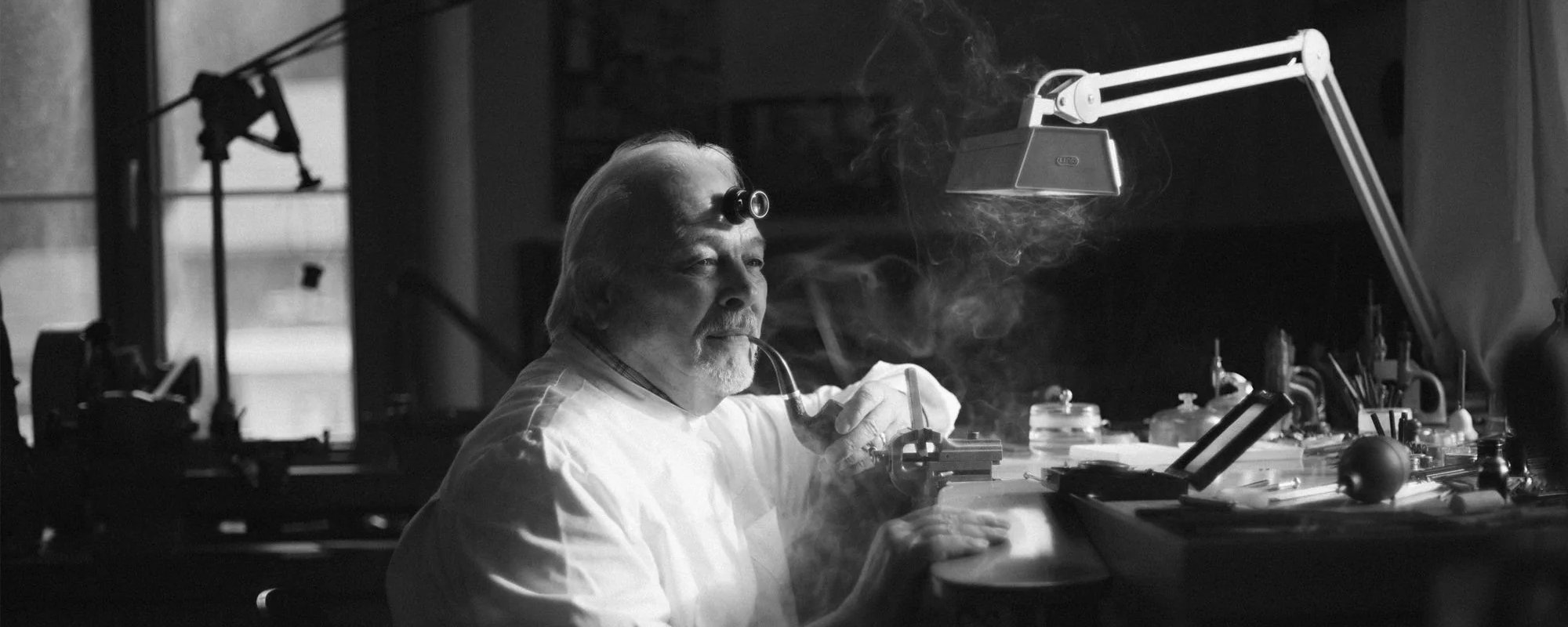
What does the Anti-AI portfolio look like? That's what I set out to answer with atlaseternal.xyz. If you're only interested in that, check out the website. The rest of this article is a peek into the thinking that brought me here.
I. The Premise
Until I was about 8, my mother spent her time juggling being a fashion designer and raising me and my sister. As a kid, I was brought into rooms I didn't fully yet understand- exhibits, trade shows, galleries and the like. During that period (among countless other things), she taught me how to read a garment: the difference between a label and a name, the way materials remembered the people who had used them well.
In part, she impressed upon me the importance of looking for things that have been around for a long time and are still alive. That probably played a big part in many of my personal interests, especially my love for horology and motorsports (I'm a sucker for well-made mechanical objects). Rarely did I think that this parallel track would intersperse with my professional interests, which has largely been around frontier technology and markets.
But as I (like everyone else) spends a majority of my time working with AI, one thing has become abundantly clear to me:
The scarce thing in a world of cheap intelligence is not the new thing. It is the old thing that is still alive. And that is valuable
II. The Investor Who Saw The Mechanism
Of course, I'm far from the only person that understands and realizes this. This is something that I think, at this point is becoming somewhat consensus.
But the process and taste to actually understanding what cultural permanence and goodwill means and convert that into real economic value, to make permanence an asset class, is nontrivial.
There's one man, though, that has done this and executed on this better than anyone else:

In 1984, Bernard Arnault put roughly 80 million francs of family money — leveraged with financing arranged by Antoine Bernheim at Lazard — into taking control of Financière Agache, the holding that, through Boussac Saint-Frères, owned Christian Dior. The group had collapsed under the Willot brothers and sat in court-supervised receivership; the French state wanted a buyer willing to absorb its roughly 16,000 textile jobs.
The reorganization is usually told as the story of a young investor recognizing that intangible assets were undervalued (famously: Arnault asked a taxi driver if he knew who the President of France was; the driver didn't but he did know who Christian Dior was).
This is correct, but the mechanical version is more useful. What Arnault concretely recognized was a conversion mechanism. Inside an operating company built around looms and bedsheets sat Christian Dior, a name that had been compounding social meaning since 1946 — through the New Look, Saint Laurent's brief tenure, and four decades of couture and proliferating licenses on ties, stockings, and eyewear.
The looms were going to zero. The name was not. He separated them.
The mechanism has a tangible accounting shape. Under IAS 38, internally generated brand value is generally absent from a company’s balance sheet. The rule treats the cost of building a famous name as indistinguishable from the ordinary cost of running the business, so it gets expensed rather than capitalized. A company can spend four decades making a brand culturally enormous without that value ever appearing as an asset.
Under IFRS 3, when control changes hands, the acquirer allocates the purchase price across identifiable intangibles at fair value. The same cultural equity, invisible while you built it, becomes a recognized asset on the day someone else buys it.
That asymmetry — invisible while accruing, visible at transfer — is what Arnault’s career industrialized. LVMH today reports 75 maisons, 31 of them over a century old, €80.8 billion of 2025 revenue, more than 6,280 stores. The compounding was not in product. It was in his ability to find names that had been compounding off-balance-sheet, buy them, and operate them inside a structure that could turn heritage into measurable cash flow.
You can see this in public artifacts like their acquisition of Tiffany and Co.. LVMH did not describe what it was buying as 300 stores or an inventory of diamonds. It described 180 years of heritage, the iconic blue box, the engagement-ring ritual, a strategic role in Watches & Jewelry, U.S. expansion. That is the language an acquirer uses when it knows what it is paying for. It is paying for a durable symbolic system with global recognition, recurring rituals, controlled distribution, and room for reinvestment under a better owner.
III. The Trade Happening Right Now
So what does Bernard Arnault have to do with AI?
As it turns out, A LOT.
Last month, Thrive Capital (huge investors in companies like OpenAI, Ramp, etc. and operators of an AI-native holding company under Thrive Holdings) launched another permanent capital vehicle: Thrive Eternal.
Joshua Kushner @JoshuaKushnerApr 24 ↗ Today we announce Thrive Eternal, a permanent capital holding company that will be concentrated in a small number of assets that we can own and steward over many decades.
Across Thrive Capital and Thrive Holdings, we are building and investing through a moment of exponential change; backing emerging technologies, the infrastructure that powers them, and the businesses they can transform.
Increasingly, we see a fourth category.
These are assets with qualities that cannot be replicated by technology. Iconic franchises and cultural institutions rooted in tradition, identity, and shared experience. In a world shaped by abundant intelligence where creation scales and distribution fragments, we believe they will matter even more.
Thrive Eternal is built on the belief that the most enduring of these assets share common characteristics: they benefit from long-term stewardship, they compound through cultural resonance, and they are enhanced by technology rather than displaced by it.
Our work at Thrive has always been informed and inspired by a deep appreciation for product, brand, and the ways in which consumers form lasting relationships with the things they love. We have been building towards this for a long time.
Our first partnership is expected to be with the San Francisco Giants - an institution built on more than a century of shared identity and community, and among the most iconic sports franchises in America. We have reached an agreement, subject to league approval, to acquire an ownership stake. We feel privileged by the opportunity to be long-term partners to the Giants.
The mandate is stated: assets with qualities that cannot be replicated by technology, concentrated in a small number of holdings to be owned and stewarded over many decades.
Bob Iger, who spent fifteen years running Disney as one of the largest exercises in cultural compounding ever attempted, signed on as an advisor. The first investment is a sub-10% minority stake in the San Francisco Giants, primary plus secondary, pending league approval.
A single firm is now sitting on both sides of a structural trade: the engine that is making content, software, design, and analytics abundant, and a portfolio of assets whose entire value rests on not being reproducible.
This is not a sentimental hedge. It is a recognition. If you believe the first thesis hard enough to write some of the largest venture checks in history into it, you have to believe the second.
This thesis, the idea that as intelligence becomes a commodity, the assets that retain value are the ones that cannot be regenerated —place, ritual, provenance, archive, lineage, trusted taste — is something that has long fascinated me.
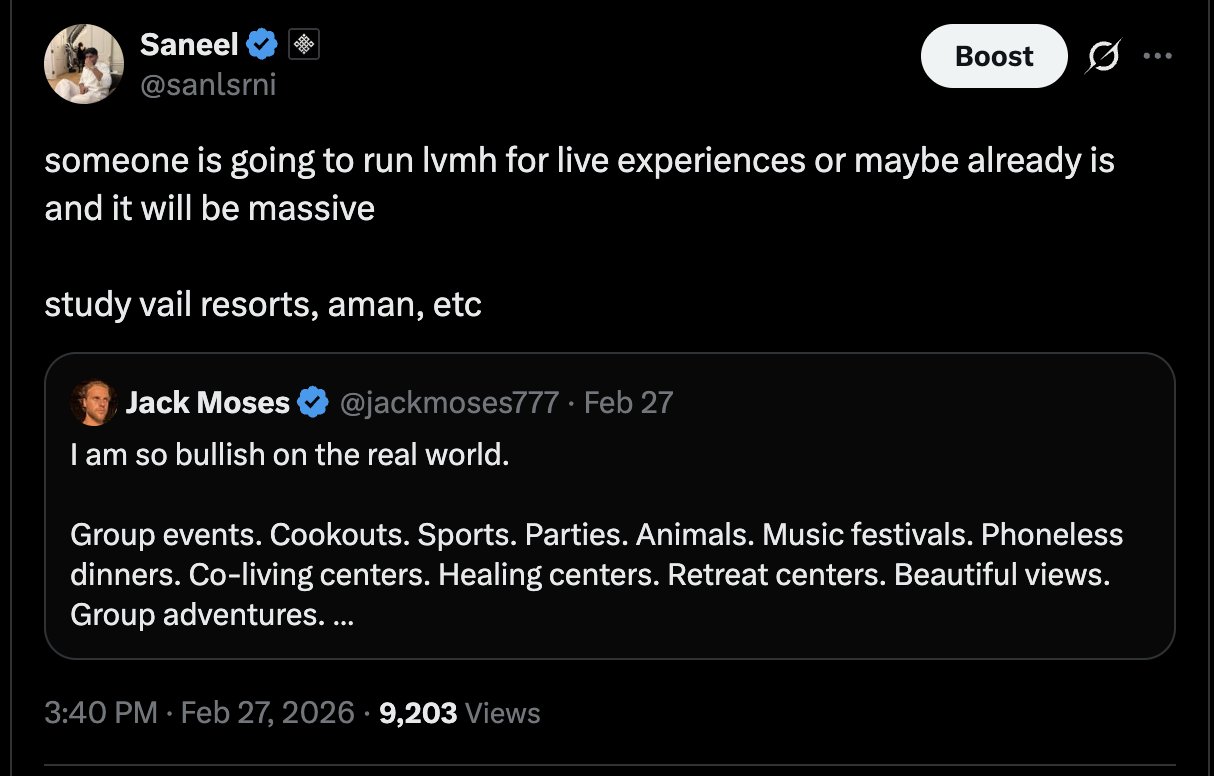
So after seeing Thrive's post, I was driven to create atlaseternal.xyz, a comprehensive atlas of the kinds of institutions that would squarely fit within this thesis. More on that in a second.
IV. The Mimetic Convergence
A useful way to see why this works is through the lens of mimetic theory. Desire, René Girard argued, is not generated internally. It is mediated, learned by watching what other people want. A cultural asset is in this sense a mimetic network: its value lives in the consensus that it matters. Tiffany is not necessarily chemically more durable than other jewelry; it is the place ageneration of people watched their parents and their movies organize the engagement ritual around. Wimbledon is not the only grass court in England; it is the one the world has agreed for a century to point at.
When content becomes abundant, this kind of socially-verified attention does not get diluted. It concentrates. The signal an audience needs in a sea of generated options is which option matters, and the answer is almost always the one with the longest unbroken consensus. AI does not flatten the cultural surface; it sharpens the difference between the Schelling points and everything else. Generated baseball commentary is a substitute for mediocre baseball commentary. It is not a substitute for the inherited fan base of the Giants, the address of Fenway Park, or the league calendar.
This is the symmetric AI thesis that Thrive Eternal and the Eternal Atlas' methodology rests on: technology is treated as a margin tailwind for these assets and a margin headwind for their generic substitutes. The compounding is mimetic on the cultural side and operational on thefinancial side, and the two reinforce each other. Every additional decade the consensus holds makes the asset harder to dislodge; every dollar of yield the owner extracts without damaging legitimacy strengthens the platform that produces the consensus.
V. The Mechanics of Conversion
The conversion from cultural meaning to durable cash flow happens through a small set of monetization engines: access (tickets, memberships, suites, reservations), rights (broadcast, publishing, sync, licensing), objects (luxury goods, collectibles, limited editions), h ospitality (hotels, restaurants, events), sponsorship, and real-estate adjacency. The quality of an asset depends on whether its engines reinforce the source of its meaning or strip-mine it.
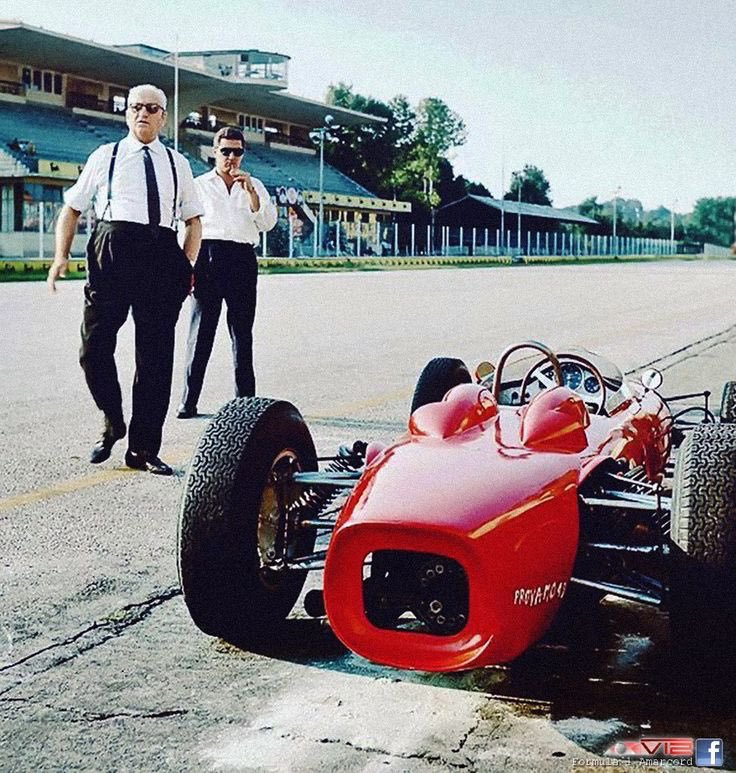
Ferrari is the cleanest illustration of restrained monetization. The company shipped 13,640 cars in 2025 and produced €7.146 billion of revenue, a 29.5% EBIT margin, €1.538 billion of industrial free cash flow, and an order book that already extends toward the end of 2027. The cars are not priced like transportation; they are priced like myth-rationing devices, and the rationing is the point. Hermès does the same thing at higher altitude: €16 billion of revenue at a 41% recurring operating margin, sustained by a refusal to let supply catch up to demand. The financial profile is almost software-like. The discipline is the inverse: under-supply, integrated craft, controlled retail.
Not every cultural asset comes with this restraint built in, and not every cultural asset is the same as its security. MSG Sports owns two of the most valuable city-based franchises in the world (Forbes values the Knicks near $9.75 billion and the Rangers near $4 billion), but FY2025 operating income was only $14.8 million, and a January 2025 reset cut the annual media-rights fees from MSG Networks by 28% and 18% respectively. The asset is unmistakable. The security is not the asset. Saregama, the century-old Indian music label that recorded the country’s first studio song in 1902, owns in-perpetuity rights to a vast catalog across fourteen languages. But the underwriting question is which fraction of that archive is actually evergreen, since most recordings decay quickly.
Literature suggests that a valuation framework has to honor those distinctions. It may look something like this:
(1) Start with normalized cash flow: owner earnings after the reinvestment required to keep the cultural surface intact.
(2) Apply the ordinary category multiple a generic buyer would assign: restaurant, venue, hotel, sports team, catalog.
(3) Add a scarcity premium only where the evidence of durable pricing power and non-replicable supply is real.
(4) Add option value for specific, probability-weighted projects the owner has the rights to execute: archive digitization, dynamic pricing, AI-enabled fan experiences, real-estate adjacency.
(5) Subtract a fragility discount for over-commercialization risk, founder dependence, rights leakage, and capex intensity.
Romance is the failure mode at every step and ultimately valuation is hard. But that's what makes constructing the anti-AI portfolio so worthwhile. A rigorous blend of taste and financial acumen is needed here.
VI. The Atlas
This is what the Atlas is. The site (atlaseternal.xyz) is a working catalog of cultural assets that may compound, both culturally and economically, as intelligence, creation, and distribution become abundant.
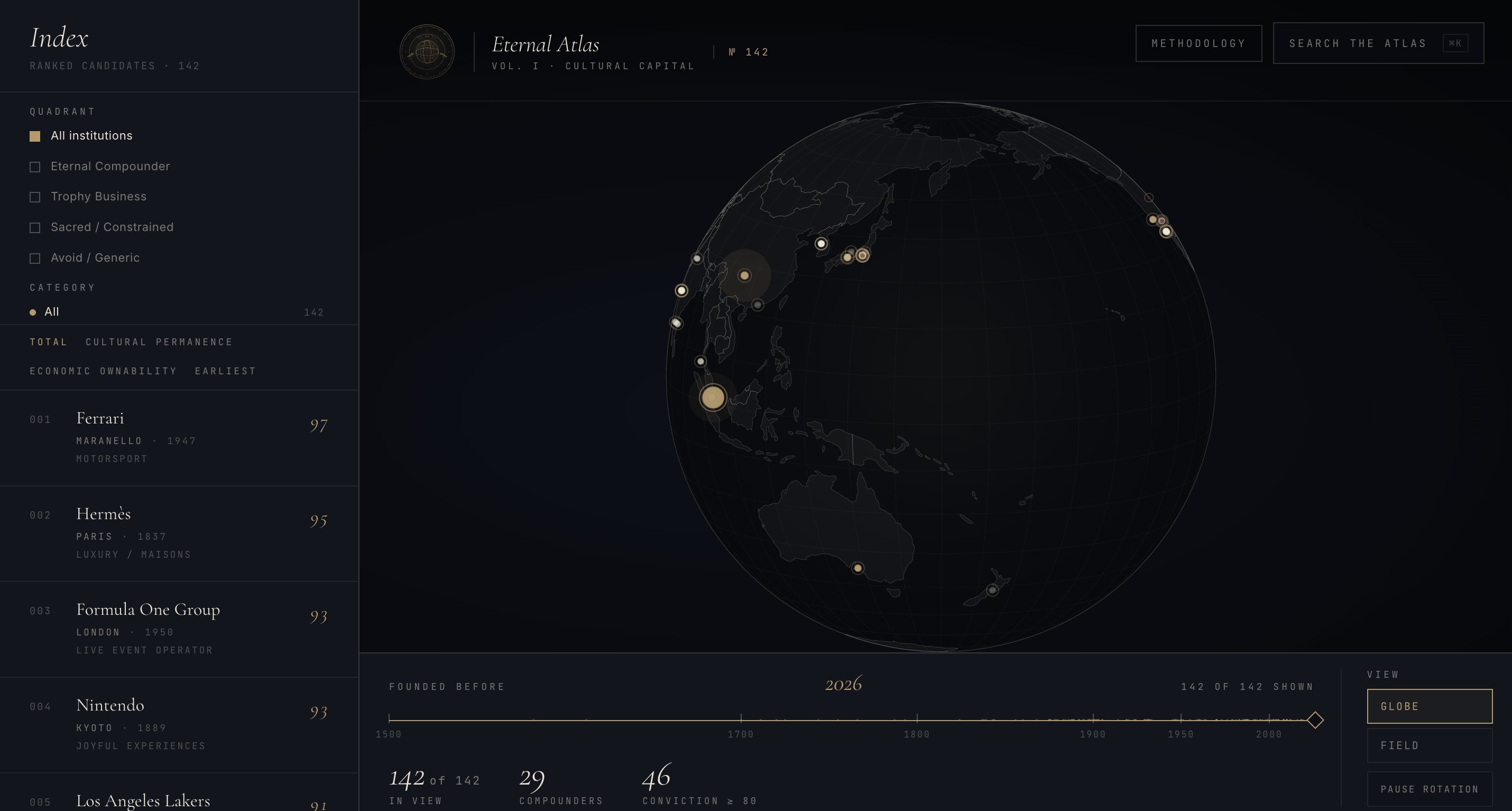
Every entry is scored on two axes: cultural permanence (the probability that the asset retains symbolic, ritual, or identity value across multiple generations) and economic ownability (the degree to which an outside steward of capital can hold, control, and compound value without dismantling the surface that makes it durable).
Both must clear. Either alone is insufficient.
The catalog sorts assets into four quadrants. Eternal Compounders are where both axes clear: proven, ownable, monetizable cultural scarcity. Trophy Businesses have ownability without necessarily having demonstrated permanence. Sacred and Constrained assets have some demonstrated permanence the world depends, but show structural difficulties in capturing that via capital Avoid / Generic is everything else: a generic influencer led festival or venue, a random tiny local museum etc.
The proof cases (Ferrari, Hermès, LVMH) are the easiest to admire and the worst to hunt in, because the market already knows. The interesting work is in the wrappers where culture has been compounding off-balance-sheet: a regional rights catalog, a family-held venue, a historic hospitality brand, a minority sports stake. The Atlas exists to find them and to mark them clearly enough (wherever they may be).
The Atlas is by far complete, either from a geographic or methodology perspective (the full ranking methodology can be found n the website). But it is meant to be a living artifact that catalogues all the assets that you may want into the Anti-AI portfolio. As always, if anyone has comments, ideas or feedback, my DMs are open.
My mother never called any of this an asset class. She said: look for the things that have been here a long time and are still alive. That phrase does most of the work the Atlas’s rubric does. The two parts cannot be separated. Old without alive is a monument. Alive without old is a trend. The combination is what compounds.
The discipline is to refuse to pay for the romance and pay only for the structure. Durable, ownable and monetizable cultural scarcity. That is the anti-AI portfolio