Technoeschatology
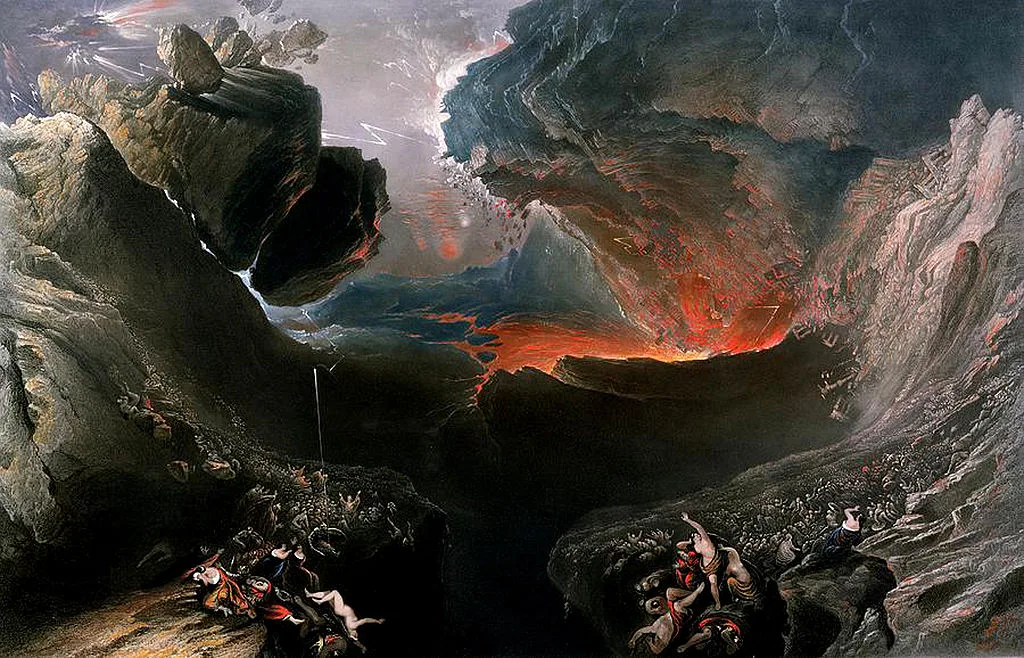
If you’re reading this and found this, nice. Outside of a very small number of people I will ask for their thoughts and review, at the time of writing this, I don’t plan on distributing this widely. This mainly serves as a more structured monologue for my own side inquiries that I wanted to just post on my site, but perhaps it will be of interest. Before you start, I’ll probably recommend reading this and this, and One Piece. Also this is very long, and I can’t guarantee that it will appear totally coherent to an external reader. Fair warning.
Almost every week since I was 12, I have patiently waited for the release of the latest One Piece chapter. I often joke that One Piece has been a bigger constant in my life than just about most things and most of my friends are probably sick of me telling them some version of “You need to read this, greatest piece of fiction ever, etc.”
What I haven’t asked myself, until recently, is why Oda’s modern epic has managed to stay so resonant throughout more than half my life. They say that the best literature ages like fine wine; it is near infinitely generative in whatever domain it purports, and continuously reveals more in accordance with the evolution of its reader. In short, it is timeless. Which is largely why I call One Piece an epic (and/or an anthology); in my mind One Piece is a continuation of the lineage of the Odyssey, the Bhagavad Gita, the Bible and so on.
Which is probably why One Piece has transcended its appeal of just another shounen; One Piece is HEAVILY Biblical.
I don’t claim this to be an original thought; perhaps the person that understood, articulated and has studied this best is none other than Peter Thiel himself. In his essay, Voyages to the End of the World; he aptly characterizes elements of eschatology and the Antichrist in transcendent literary works across multiple time periods: New Atlantis, Gulliver’s Travels, The Watchmen and One Piece. Amongst all of them, Thiel draws connections between the motivation and backgrounds in his authors, the stories they’ve told, the potential various interpretations of the Antichrist, and their parallels to the learnings of Judeo-Christian scholars and texts.
Understanding Luffy in One Piece as Christ-like is straight forward. Understanding the overarching protagonist Imu as the Antichrist is even more so and especially prescient; when Thiel wrote his essay, Imu had not been revealed. Now that he has, he is understood to be viewed as a “false god”, with a heavily demonic appearance and a stringent belief that a unified, dominated World Government is the only way to prevent strife. For anyone familiar with eschatology and the characteristics of the Antichrist, this is eerily spot on. There are numerous other parallels that in retrospect are clear but in the moment unclear to the unassuming mind but I digress.
So why have I spent 4 paragraphs and a chunk of your time talking about One Piece in an essay called “Technoeschatology”?
Well, partly because I had no idea how to start this thing, and partly because it is incredibly difficult, once read, to NOT see the parallels between Thiel’s fascination with the subject, One Piece and the rest of the works he analyzed, and our modern world.
What is particularly striking about both the analysis in Voyages to the End of the World and The Pope and the Antichrist is the remarkable consistency in the eschatological lessons that can be adopted from fiction across multiple disparate time periods in modernity, and the real experiences and fascinations of the Papacy (Pope Benedict XVI) with the Antichrist and quasi figurae Antichristi. At the risk of sacrificing nuance, I will draw out I think the most critical for this essay:
- The Antichrist is a counterfeit and not an opponent. One of the most consistent claims is how similar, and potentially “more” Christ-like, an Antichrist seemingly appears. Hippolytus describes it as a lamb outside and a wolf within. Signorelli paints him in the likeness of Christ. Matthew 24:24 states: “For there shall arise false Christs, and false prophets, and shall show great signs and wonders; so as to lead astray, if possible, even the elect.” Ozymandius in the Watchmen is a seeming pacifist and a vegan. The Antichrist cannot be identified easily primarily because it appears within the consensus of what is seemingly Good and not as something that is Evil.
- The Antichrist purports itself as “relief” to problems and is welcomed. Thiel proposes that Joabin in New Atlantis is potentially the Antichrist-like figure as the General Secretary of Salomon’s House. And in accordance with that, we can trace the action of Salomon’s House with this line of thought: Gulliver’s crew is healed by miraculous technology and the chaplain (narrator) takes ducats from a civilization that has purported to have built a better Tower of Babel (and thus renouncing his faith). Ozymandias DOES establish peace in the Watchmen; but only after his clandestine massacre of millions forcing a unified world government post Cold-War. In every universal case, the Antichrist appears as a “savior”.
- The Antichrist is not interested in the throne, but power over the substrate. Ozymandias is not a head of state but rather the head of a powerful corporation. Joabin is not the king of Bensalem but rather the general secretary of its most powerful apparatus (a state-sponsored technological behemoth). Imu remains hidden and the world is largely unaware of his presence, despite his absolute control over the World Government (and its absolute control over the world). The Antichrist purports control over the unified governance substrate without itself being seen as the clear head of that substrate.
- The Totality brought by the Antichrist closes all exits. One of the core arguments of the actions of the Antichrist is the totality of the substrates which it enacts. The Struldburgs in Balnibarbi, which is the purgatory of Laputa (the island above the country), is symbolic of this: granted biological immortality, yet susceptible to aging and senility all the same, forever stuck at the mercy of the Antichrist-like king of Balnibari. The World Government in One Piece bears no disobedience; Imu’s goal is totality of control and the pirates and revolutionaries that fight against it can be seen as a biblical struggle for the absence of this. If the Antichrist heralds a system that closes off the unexpected (a completely unified world-government, or a company that can solve all problems and herald utopia), then Totality must be its defining feature.
- The order brought by the Antichrist comes at hidden, immense costs. Ozymandias killed millions in New York in a bid to end the threat of nuclear war. Salomon’s House has complete control over which inventions get distributed, even if those inventions may be helpful generally. The World Government and Imu forbid study of the Void century. The Totality of the Antichrist’s substrate is not without sacrifice, however hidden
If you’ve made it this far, you’re either (a) still wondering what this has to do with the “techno” part of technoeschatology or (b) are increasingly aghast at any parallels you may have drawn with technological discourse today.
Because indeed, many of the characteristics that are being described place an incredible burden on our more recent advancements. Before I begin the exposition, I want to be clear that I am not so bold as to assign any individual as quasi figurae Antichristi; there’s far too much nuance (and internal contradiction) in any strict interpretation.
Yet, it is seen and has been seen. AI and the companies dedicated to pushing the frontier have both purported it as the technology at the end of times, the miracle that will abolish disease and menial work and war. At the same time, talks of “pacing the frontier”, of safety concerns, of the need for third-party evaluators and unified frameworks between the US and China have come to dominate discourse as model capabilities exponentially compound. Recent outrage over fears of extinction, and p(doom) and the “10% chance it kills us all in this decade” are fuel to the fire, and give way for the possibility of institutions that COULD become the substrate that enact Totality. Thiel talks of two singularities; the known one (technology escalates beyond human control) and that of the Antichrist, where concerns over the first enable the substrate described axiomatically above.
Does this mean that the leaders of the frontier, or the safetyists are themselves the Antichrist?
My bias is probably not. The Antichrist needs to be popular (which Dario/Sam are not necessarily, at least at mass scale) and is usually hidden in their influence. AI safety is a real concern, and I am made to believe that many of these folks do genuinely worry about this. But at the least, it is very difficult to not trace the evolution of perceived existential threat from a miraculous technology, the frontier of which is controlled by centralized powerful institutions, who are purporting for more regulation and safeguards (from “third-parties” that may or may not have interlinked financial ties to these leaders).
The broader point is that this technology has been co-opted as apocalyptic overwhelmingly in public discourse, which is a stark divergence from how technology “used” to be construed which was generative and utopian. Yet, you might also note that those two things are faces staring at each other in a mirror, since there is also discourse to the contrary (often from the same entities advocating for pacing).
Which brings me to another point: dualism. What literature and eschatology reveal is the immense difficulty in separating out the Antichrist from being remarkably Christ-like. The Antichrist promises salvation in the form of utopia, but that comes via the substrate that enacts totality and closes all exits. The Antichrist would NOT, for example, advocate necessarily for open AI accelerationism, which may come at the cost of large-scale cyberattacks or empowering people with dangerous knowledge on how to enact Violence (i.e. make a bioweapon). Which makes it really hard to toe the line between understanding when utopia at no costs will lead to the substrate of totality purported by the Antichrist and the very real problems that come when veering in the opposite direction.
It's in these contradictions that I find it increasingly hard to reason, primarily because we see microcosms of what we have studied in everything and those microcosms are in tension. One could argue that China’s structure under the CCP is reminiscent of Salomon’s House or the World Government; an institution that has undoubtedly boosted the quality of life of its subjects but one that purports totality and closes exits (see: increasingly harsher capital controls on money leaving China). Yet, Chinese labs today are at the absolute forefront of efficient, open-source AI with capabilities lagging the frontier by 1.5-3 generations.
If we’re being axiomatic, the democratization of access to these models absent a unified regulatory body to govern their release would be the opposite direction of what we might expect. To the contrary, America does NOT close exit and is not a substrate that purports totality, yet our AI labs bear more similarities to Salomon’s House in New Atlantis than any Chinese lab does. So we have a substrate closer to what might be imagined coming from the Antichrist producing a version of technology that is in opposition, and institutions that seem Antichrist-like born of nation that at core is opposite to the substrate of totality. The cognitive whiplash of that is staggering.
Beyond AI, the question I have is also how might we classify different technological frontiers as Christic or Antichristic? Certainly, blockchains and open networks appear closer to the Pentecost than they do to Babel, but they now exist in a gradation between truly distributed/sovereign (ZEC) and their co-option into existing financial institutions that have varying degrees of openness. Peptides, too, as in popular discourse; the current state of affairs is a strange mix of regulated and unregulated substances being distributed to users, which I view as a microcosm more broadly of what may happen with accelerated drug discovery. Does it require bending the knee to a stringent FDA or other authority? Will fearmongering be used to solidify power around this substrate? Or will an institution like the FDA adopt its American values and pave the way forward for faster progress? All of this is unclear to me, and since this is currently the limit of my coherence on this subject, it's an exploration that will be left for another time.
Ultimately my takeaway is that we should be taking MORE risk and leaps with the technology at our disposal while also being mindful of making sure our institutions do not evolve to close all paths to exit. Because while technology unbounded has its own risks, belief in the apocalyptic nature of technology can lead to the more sinister singularity in quasi figurae Antichristi and the resultant substrates of totality.