Fossil Fools
Spoilers ahead for the movie Digger.
Digger is probably the most ambitious movie I’ve seen in a long time.
It’s a weird thing to say about a film that apparently is going to lose $250M on a spectacular box office bomb (maybe we’re all still reeling from the Odyssey hype?) and has Tom Cruise acting in something that’s not the 75th installment of Mission Impossible. And yet, the point of Digger is going to be lost on so many people.
Look, the cinematography is phenomenal. The plot devices are fantastic (a show within a show after the actual thing). But at some point, probably halfway through the film, when Tom Cruise’s character Digger Rockwell is brought before an angry mob of European legislators, I’m sitting there and asking myself:
What are the odds Iñárritu (director) has read Girard?
In retrospect, not insignificant at least; this is the guy that made Birdman and the Revenant and a bunch of other films reflecting the human condition. But Digger is such a direct admission of Girardian principles, of mob violence and finality, on so many levels, that you can’t help but wonder if much of this was taken from a certain French philosopher and all his offshoots of ideology.
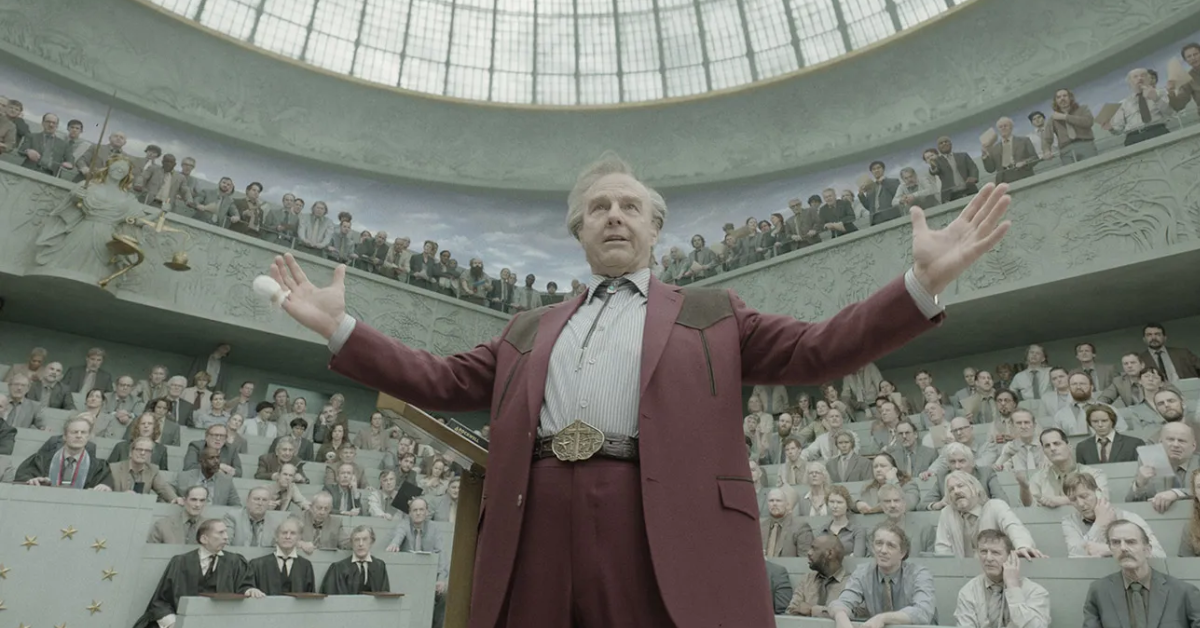
Because as you’re sitting there watching Digger Rockwell in this room, the coloring is all very intentional. A man sits at the center of a room in a red suit and cowboy hat giving a psuedo-sermon on the value of oil in the wake of a cataclysm of his own doing. He is surrounded by a mob of monochromatically dressed European politicians, who are only made present as a collective in their screams and shouts and chanting of “Blah Blah Blah”.
This is broken only by 7 judges dressed in black, and every time this room of politicians threatens to converge their violence and distaste on Digger, these 7 black suits intervene, until Digger finishes his speech. And you sit there and it’s hard not to see the parallels: there is some desired resource (oil), the extraction of which has caused a huge ice shelf to hit Europe (cataclysm), a mob that wants to converge their violence on the sacrificial (the politicians on Digger), an intervention by the suits in black (the State holding back violence) and a speech that could only have been inspired by a fire and brimstone preacher.
And then you see it again and again and again through the film. You see the President of the film in his final days try and find anyone to shift the blame (as he is implicated as well): China, Russia, someone else (searching for another scapegoat). You see this constant tension between reality of the cataclysm and Digger/the President’s desire to control perception and the narrative (mimetics!). You see the President get the delusion that he is the divine and thus should nuke Russia to solve the situation.
You see it when you realize half the film is really a play being made about actual events, and there’s tension between the actor playing Digger and the Director of the play over whether it should be funny or tense or real or scary. You see it when the person financing the play (Digger’s real nephew) diffuses this tension and basically admits that the first time he saw the play (called Fossil Fools) he stood up and cheered for his family’s denouncement and deaths with the rest of the mob. He directly acknowledges that the entire point of the play is to basically diffuse violence by giving a fictional narrative around which to rally the mob.
And you see it at the end. You really see it at the end. You see it because there’s been tension in making this play, and the play only ends when Digger, in exile, decides to end his life (the inescapable sacrifice). Right before he ends his life, he leads a sermon with the straddled crew he’s exiled with and is given a Divine (false) vision of abundance. The play ends shortly after with his decision to take his life, and that’s when the audience cheers, and the play concludes, and all the tensions in making the play between the actors and directors finish. And the real nephew of Digger smiles to the side, because he’s given the people a way to diffuse violence.
But when the play finishes, the people file out of the theater into a post-apocalyptic world. The play was satire on events that already transpired and led to the eschaton (apocalypse). Following the Girardian vein, that’s an even MORE direct admission: the play is just a facsimile of the rituals that reset rising mimetic tensions in a common sacrifice. It’s not the actual thing, and as Girard would suggest, trying to defer the actual thing does, in fact, lead to apocalyptic events.
There’s a few more (clever use of red lighting!) but I’m running the risk of droning. The point is: I can’t remember the last time I saw a film and felt so viscerally and truly that it was a direct admission (vindication?) of all the still somewhat fringe beliefs that Girard, eschatology and other authors have spawned. I have no idea if Iñárritu has read Girard. But because so much of the movie clearly fringes on the Biblical, it means either way he’s rederived the same conclusions.
I probably won’t watch it again, but I’ll be thinking about it for a long time. If you’ve read this far through my ramblings, go watch it (preferably in theaters) and keep an open mind. It transcends far beyond another black comedy political satire, but you can’t expect that to be found in the minds of a generation fried by the 15 second videos in front of them.